You hit submit. Now what?
Most advice tells you to "follow up professionally" and leaves it there. What it doesn't tell you is that following up at the wrong time, in the wrong way or too many times can actually work against you. Recruiters notice. ATS systems log contact history. And a poorly timed message can shift your application from "promising" to "persistent in the wrong way."
The real question isn't whether to follow up. It's when, how and whether it will actually move the needle.
- Follow up 5 to 10 business days after applying, not 2 days later.
- The best follow-ups are short, personalised and useful, not generic “just checking in” messages.
- Following up helps when it adds value or follows a referral.
- Following up does nothing when it’s too early or says nothing specific.
- Following up hurts when you ignore instructions, message too many people or chase too often.
- Keep it to 2 to 3 total follow-ups max, spaced out over time.
- While you wait, focus on what actually drives results: better applications, stronger prep and networking.
- The follow-up is not the whole strategy. It’s one small part of a well-run job search system.
This guide cuts through the generic advice. We'll cover the optimal follow-up window (backed by recruiter data), the 3 scenarios where following up helps, does nothing or hurts your chances, and the exact templates you can use for email and LinkedIn. No filler. Just a clear game plan.
The follow-up window most people get wrong
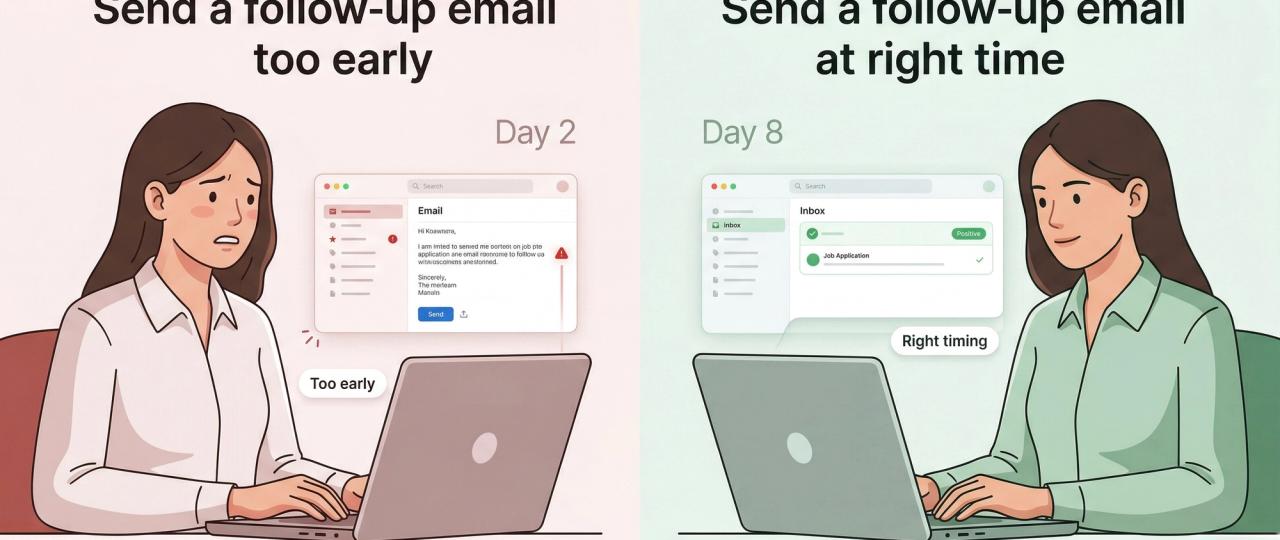
The most common mistake is following up too soon. Sending a message 2 days after applying doesn't signal enthusiasm. It signals that you haven't thought about how hiring actually works.
Here's the reality: the average hiring process in 2025 to 2026 takes 42 to 44 days from posting to offer. Hiring managers aren't reviewing your CV the morning after you applied. They're batching applications, aligning with internal stakeholders and often waiting for the posting to close before reviewing anyone.
The data-backed window is 5 to 10 business days after submitting your application. According to EmployBridge, a good rule of thumb is to follow up about a week after submitting your application. A survey of HR managers found that 36% prefer candidates to follow up 1 to 2 weeks after applying, while 29% are comfortable with less than a week.
What to do before you follow up
Before you send anything, check these 3 things:
- Re-read the job posting. Some postings explicitly say "no follow-up calls or emails." If it does, respect it. Ignoring that instruction doesn't make you stand out. It gets your application flagged.
- Check whether a deadline was listed. If applications close on a specific date, wait until after that date before getting in touch. The hiring team won't review anyone until the pool is complete.
- Find the right person. A follow-up sent to a generic HR inbox often goes nowhere. Search LinkedIn for the recruiter or hiring manager tied to the role. A personalised message to the right person is worth 10 generic ones.
When following up helps, does nothing or hurts your chances
This is the part most guides skip. Not every follow-up is equal. The outcome depends on context, timing and how you do it.
When it helps
Following up works when it adds something. That might be a brief, specific reminder of your interest, a relevant achievement you didn't include in your original application or a genuine question about the role or team. The key word is adds. If your message gives the recruiter a reason to open your CV again, it's done its job.
It also helps when you have a referral. If someone inside the company recommended you, a follow-up within 3 to 5 days is appropriate and often expected. According to the American University Kogod School of Business, personalising your message by addressing the hiring manager or recruiter by name, found via LinkedIn, the job posting or your network, is one of the most effective things you can do.
When it does nothing
If the posting just closed yesterday and you're sending a follow-up, it will almost certainly be ignored. Not because you did anything wrong, but because the recruiter is in the middle of sorting through a full inbox. Your message is noise at the wrong moment.
Similarly, a follow-up that says nothing more than "I just wanted to check in on my application" adds zero value. It doesn't remind the recruiter why you're a strong candidate. It just takes up space in their inbox. Generic follow-ups get generic outcomes.
When it hurts your chances
This is where candidates do real damage.
- Following up more than 2 to 3 times signals desperation, not enthusiasm. Career strategists and recruiters alike note that repeated outreach can move an application from active consideration to the bottom of the pile.
- Contacting multiple people at the same company about the same role. If the hiring manager and the HR coordinator both receive your follow-up on the same day, it reads as disorganised at best, manipulative at worst.
- Ignoring a "no follow-up" instruction. This one is simple: if the posting says don't, don't. It's not a test of your persistence. It's a filter.
- Following up after a rejection. If you've received a no, asking for reconsideration rarely works and often leaves a poor impression for future applications at that company.
Unlock your career potential today

Experience the power of Ask Tua and run your whole job search in one app.
Follow-up templates you can use today
Keep every follow-up to 3 to 5 sentences. Hiring managers are busy. A concise, professional message that respects their time will always outperform a detailed pitch they didn't ask for.
Template 1: standard first follow-up (email)
Use this 7 to 10 business days after applying when you haven't heard anything.
Email template
SubjectFollow-up: [Job Title] application, [Your Name]
Hi [Name], I wanted to follow up on my application for the [Job Title] role, submitted on [date]. I'm genuinely interested in [specific thing about the company or team] and believe my background in [one relevant skill or experience] would be a strong fit. Please let me know if you need anything further from my side. I look forward to hearing from you. Best, [Your Name]
Template 2: LinkedIn connection request (with a note)
Use this when you can identify the hiring manager or recruiter on LinkedIn and want to make a personal connection.
Message template
Hi [Name], I recently applied for the [Job Title] role at [Company] and wanted to connect directly. I'm particularly drawn to [specific aspect of the company or team]. Happy to share more about my background if useful.
Keep it under 300 characters. LinkedIn connection notes are short by design; treat them that way.
Template 3: second follow-up (if no response after first)
Wait 2 to 3 weeks after your first follow-up before sending this. Keep the tone light and professional, not frustrated.
Email template
SubjectChecking in: [Job Title] application, [Your Name]
Hi [Name], I'm following up again on my application for the [Job Title] role. I remain very interested in the opportunity and in [Company Name]. If the role has moved forward or the timeline has shifted, I'd appreciate a brief update when you have a moment. Thank you for your time. [Your Name]
Template 4: when you have a competing offer
Only use this if it's true. It creates genuine urgency and can accelerate a decision, but using it dishonestly will damage your credibility.
Email template
Subject[Job Title] application: update on my candidacy
Hi [Name], I wanted to be transparent: I've received an offer from another company and have been asked to respond by [date]. The [Job Title] role at [Company] remains my first choice, and I'd welcome the chance to discuss my application before I make a decision. Thank you for considering my candidacy. [Your Name]
What to do while you wait (this is the part that actually matters)
Here's the uncomfortable truth: for most online applications, the follow-up email isn't what gets you the interview. Your CV, your cover letter and whether you know someone at the company are what move the needle.
Research consistently shows that 70% to 80% of roles are filled through personal connections, not job board applications. That doesn't mean online applications are pointless. It means that while you're waiting, the highest-value thing you can do is work your network in parallel.
Use the waiting period strategically
- Connect with people at the company on LinkedIn. Not to ask for a referral immediately, but to build a genuine connection. Comment on their posts. Ask a thoughtful question about their work. Make yourself a recognisable name before you need anything.
- Research the team. If you get to an interview, knowing who you'd be working with and what they're focused on is a significant advantage. Use the waiting period to prepare, not just to refresh your inbox.
- Keep applying. This is the most important one. A single application in progress is not a strategy. The candidates who land roles fastest are the ones running multiple active applications at once, tracking each one and following up on all of them at the right time.
The follow-up is one small part of a bigger system
A well-timed follow-up can nudge a stalled application forward. But it can't rescue a weak CV, a generic cover letter or a role you're not well-matched for. Think of it as the final 5% of a job search strategy, not the whole game.
The 95% is your CV, your applications, your prep and your network. Get that right first.
Following up with a recruiter promptly and professionally is a necessary step in the job application process to showcase your enthusiasm for and commitment to the role.
The follow-up works best when everything behind it is already strong.
The short version
If you take nothing else from this:
| Scenario | What to do |
|---|---|
| Just applied | Wait 7 to 10 business days before following up |
| Posting said "no follow-ups" | Don't. Move on. |
| You have a referral | Follow up within 3 to 5 days |
| No response after first follow-up | Wait 2 to 3 weeks, then try once more |
| Still no response after 2 follow-ups | Stop. Focus elsewhere. |
| You have a competing offer | Be honest. Send Template 4. |
Job searching is a system. The follow-up is one part of it. The candidates who get offers are the ones who have every part working together: the right applications, a strong CV, good prep and a clear view of where every opportunity stands.
Ask Tua is the coaching app for your whole job search. Find relevant roles from 5,600+ UK companies, target your CV to each role, track applications and follow-ups, and learn what earns interviews.